

Harmonix 360
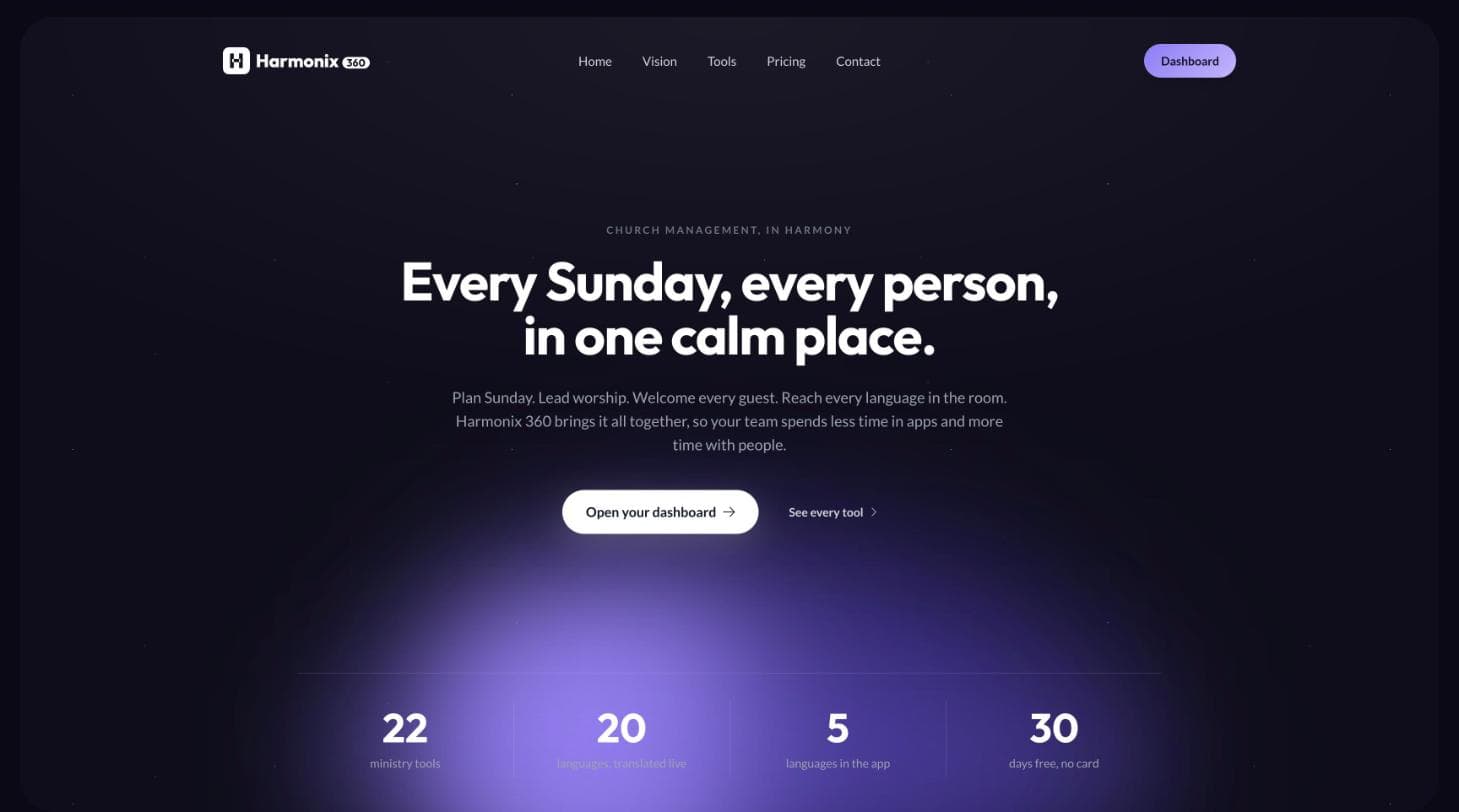
Twenty-two tools organized the way a church actually works, from Sunday planning and kids check-in to giving, plus live sermon translation into twenty languages on every listener’s phone.
- Role
- Product design & full-stack engineering
- Year
- 2026
- Stack
- ReactViteNode.jsExpressSocket.io
The problem
A group chat for worship. A spreadsheet for volunteers. A drawer full of guest cards. Every one of those systems works, until the week it doesn’t.
A first-time guest fills in a card and never hears back. The worship leader finds out on Saturday that the drummer is away. And in congregations that worship across languages, part of the room only half-follows the sermon every single week.
Constraints
Most of the people using it are volunteers, not admins, and many of them are reluctant with technology. Anything that needed an app download or an account would quietly not get used.
The stakes are real: children’s check-in has to be fast at the door and airtight at pickup, money must settle directly to each church, and member data falls under GDPR. Live translation has to stay a few seconds behind the speaker, and a dropped laptop tab in the sound booth can’t be allowed to silence the listeners.
Approach
I modeled the product on how a church is organized, not on a generic CRM. Departments unlock the tools each ministry uses: access follows the department, not a forty-item checklist.
Every person exists once. The guest who checks in on Sunday is the same person a group leader messages on Tuesday; nobody is typed in twice.
And I designed for the person who will never log in: volunteers tap Yes or No straight from an email, and giving, events, groups, the prayer wall and live translation each get a public page at the church’s own address. Print the QR code once and it works every week.
A guest who checks in on Sunday is the same person a group leader messages on Tuesday. Nobody is typed in twice.
What I built
Harmonix 360 brings planning, people, worship, kids, giving, groups, messaging, pastoral care and live translation into one platform with a single plan. The interface itself runs in five languages, because the people running the church often worship in a different language than the software they’re used to.
Live translation is metered per language-minute, so churches only pay for what they stream, and every gift settles directly to the church.
- 01
The sermon, in twenty languages
Listeners scan one QR code and hear a natural voice on their own phone, a few seconds behind the speaker, with live captions for deaf and hard-of-hearing members.
- 02
A booth built for Sunday pressure
A feed from the mixer, a level meter, Start, Pause for prayer and songs, Stop. If the booth tab drops, listeners never notice.
- 03
Every Sunday planned, staffed, confirmed
Reusable orders of service, a sermon calendar, and volunteer schedules confirmed by email with automatic reminders.
- 04
Worship that transposes itself
Import a chord chart from a photo, PDF or ChordPro file. Type chords once, every key follows. Stage Mode for Sunday.
- 05
Kids check-in parents can trust
A tablet at the door, name tags that print themselves, and a pickup code that gives parents real peace of mind.
- 06
Giving with a story
Apple Pay, bank transfer and recurring gifts; campaign pages with live progress bars; year-end statements that send themselves.
Results
Harmonix 360 is onboarding churches through a waitlist, sized to the team’s capacity to support them well. Each church is set up within a day and runs a full 30-day trial. The fastest way to see if it fits is to run one real Sunday on it.
People can be imported straight from Planning Center, so switching doesn’t mean starting over.
What’s next
New tools continue rolling out through 2026, shaped by the churches already using it. The priority is depth over breadth: making the twenty-two tools that exist feel inevitable before adding a twenty-third.